Bytebase Security Details
Last modified:
General practices
- Access to all internal systems is protected by multi-factor authentication.
- Access is restricted to those who require it to perform their job, and is regularly reviewed and revoked upon termination or when no longer needed.
- The entire codebase is open-sourced on GitHub. Code reviews are mandatory for all code changes.
- The software components are monitored for CVEs.
- 3rd party conducts penetration tests annually.
- We don't copy production data to external devices such as personal laptops.
Bytebase overall architecture
- Backend is written in Go.
- Frontend is written in TypeScript and Vue3.
- Metadata is stored in PostgreSQL.
- The Bytebase release is a single Go binary that uses Go embedding to embed the frontend assets as well as the PostgreSQL binary. In another word, one can start Bytebase simply by ./bytebase.
- One can store the metadata in an external PostgreSQL instance instead of the embedded one.
Bytebase Cloud
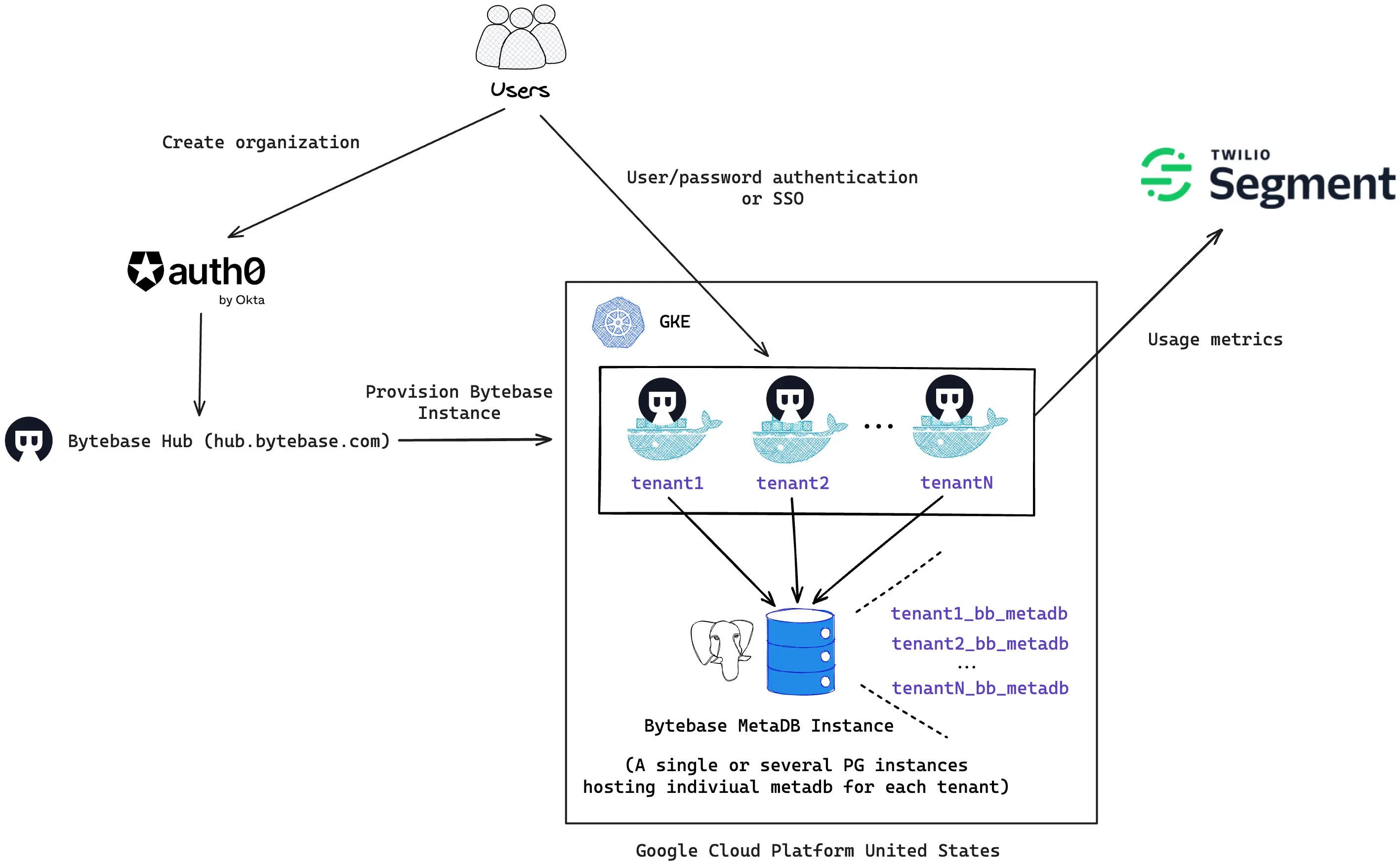
- All infrastructure is hosted on Google Cloud Platform us-central region and managed through Terraform.
- Each customer Bytebase workspace is running inside a separate container managed by Google Container Engine (GKE).
- The metadata is stored in a shared pool of Google Cloud SQL PostgreSQL instances. Storing metadata in a dedicated PostgreSQL instance is available in our Enterprise plan upon request.
- User authentication with the Bytebase Hub is via Auth0.
- Anonymous usage metrics are collected and sent to Segment. Collection can be disabled upon request in our Enterprise plan.
- The customer Bytebase workspace will be deactivated automatically if there is no traffic in 48 hours. The data will be purged in 60 days after deactivation.
Bytebase self-hosted
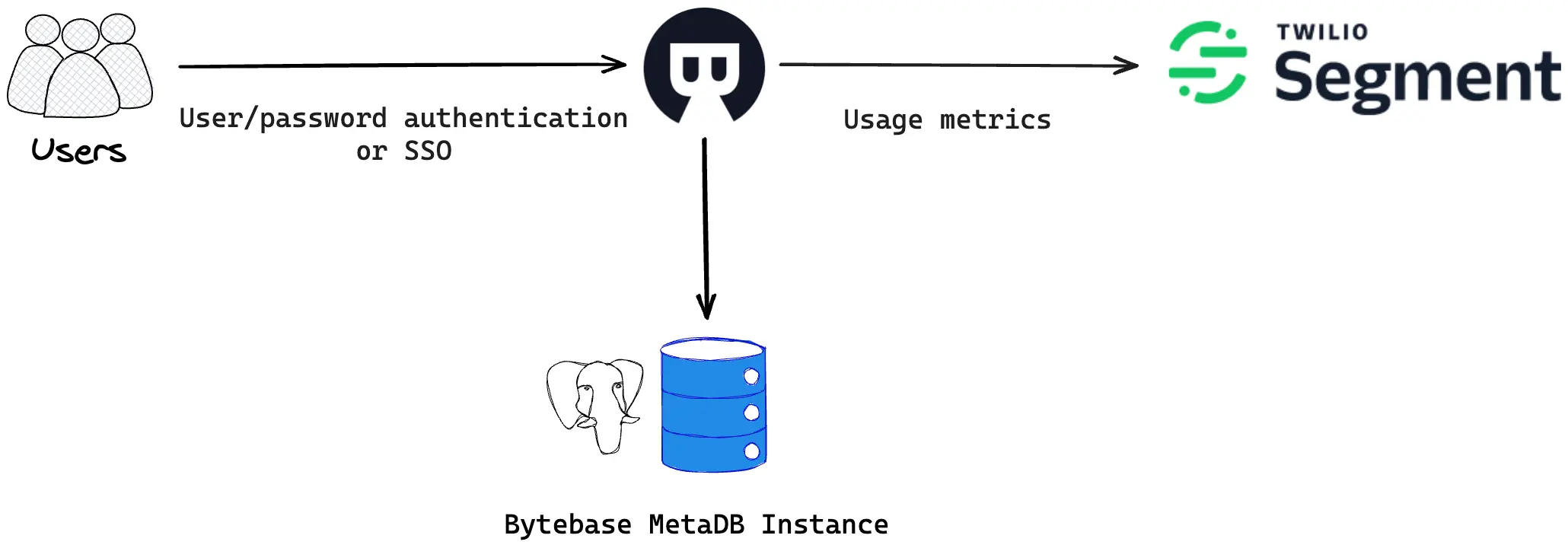
- The architecture is similar to Bytebase Cloud. You can run Bytebase inside docker or on bare-metal.
- Anonymous usage metrics are collected and sent to Segment. Collection can be disabled in the workspace settings.
Shared practices between Bytebase Cloud and self-hosted
- The registered email and name of the first member is sent to Bytebase. We use this to contact regarding sales opportunity, security updates, policy updates, and product updates.
- User/password authentication is enabled by default. SSO with the Bytebase workspace is configurable via OAuth, OIDC, or LDAP. 2FA and Sign-in restriction can be further enforced in the Enterprise plan.
Policy and procedure retention
Bytebase retains all privacy, security, and operational policies and procedures for a minimum of seven (7) years from the date of creation or the date when they were last in effect, whichever is later. This retention practice is maintained in accordance with the following regulatory requirements:
- HIPAA §164.530(j) — requires retention of policies and procedures, and documentation of required actions, activities, or assessments for six (6) years.
- Sarbanes-Oxley Act (SOX) Section 802 — requires retention of audit workpapers, financial records, and related communications for seven (7) years.
- Bank Secrecy Act (BSA) / Anti-Money Laundering (AML) — requires retention of transaction records, Suspicious Activity Reports (SARs), Currency Transaction Reports (CTRs), and customer due diligence documentation for five (5) years per 31 CFR §1010.430.
Policy documents are versioned, and prior versions are archived for the full retention period. Bytebase applies the longest applicable retention period across all frameworks to ensure simultaneous compliance.
Audit Logs
Bytebase collects audit logs for user operations inside Bytebase. Bytebase retains audit history for a minimum of seven (7) years to satisfy HIPAA, SOX, BSA/AML, and other compliance requirements. The audit logs can be readily accessed for analysis from the Audit Log section inside the Bytebase product, and can be streamed to external SIEM platforms for long-term archival.
FAQ
Which certification does Bytebase have?
SOC 2 Type II.
Which data does Bytebase store?
Bytebase stores the following data:- Database connection info.
- Database schema.
How do I report a potential vulnerability or security concern?
Please contact us by e-mail at support@bytebase.com and we'll get back to you ASAP.